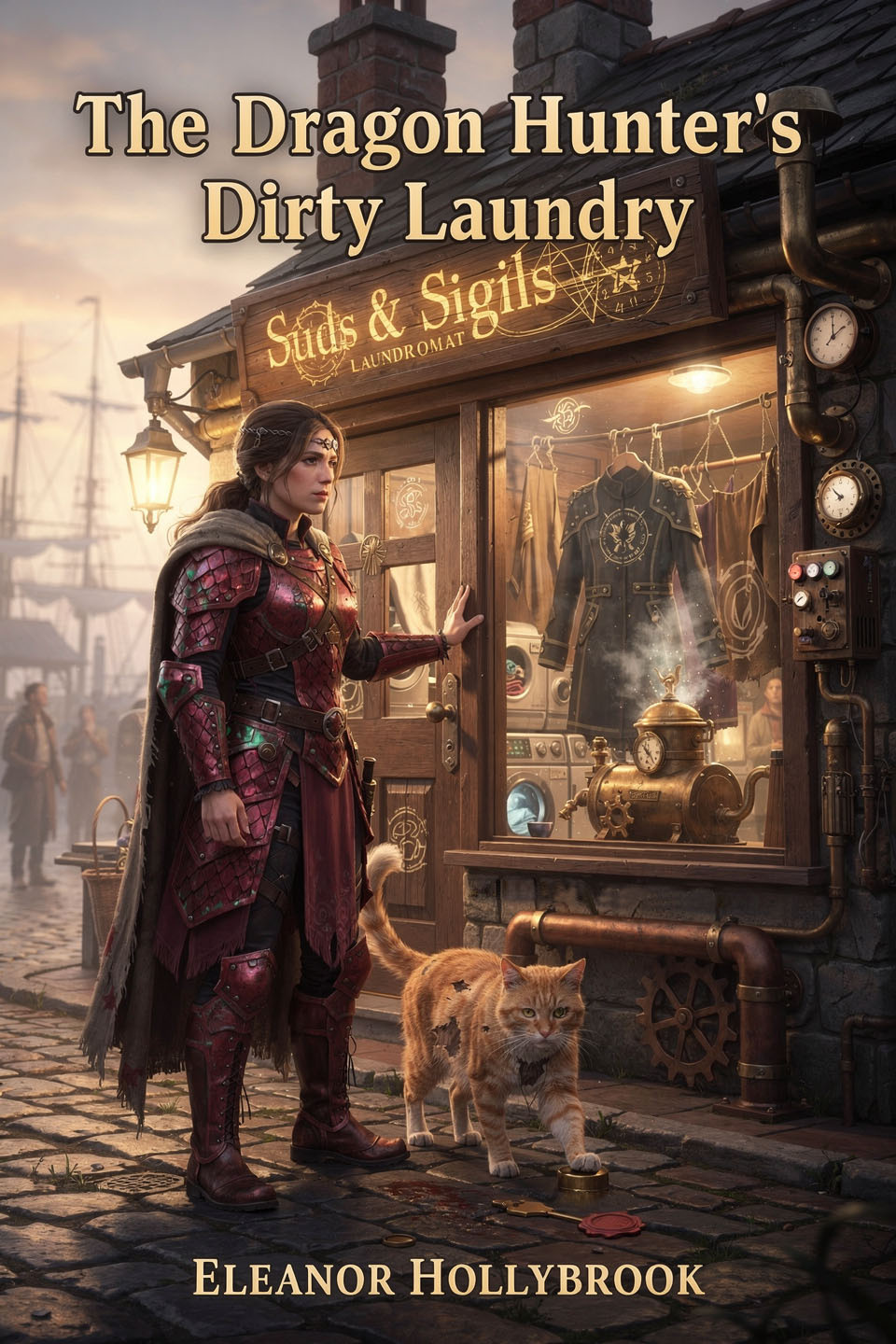
Curses removed. Armour restored. False names washed clean. Dragons welcome by appointment.
The book
A hero comes home. The town has not cleaned up after itself.
Kaela Veyr survived dragons, mercenary campaigns, and the sort of battlefield decisions that follow a person home. She returns to Brindlewash after her parents' deaths expecting grief, paperwork, and a quick exit. Instead, she inherits The Suds & Sigils Laundromat.
The Suds & Sigils does not just clean clothes. It lifts curses, scrubs blood from armour, removes binding marks, and occasionally coughs up evidence that polite society would rather keep buried.
The town insists Kaela's mother was involved in money laundering, blackmail, illegal identity work, and worse. The rumours are ugly enough to sound convincing. The truth is stranger, kinder, and far more dangerous.
With her mother's ghost flickering through the wash cycle, old rivals circling, and Crumpet stealing anything that might be important, Kaela has to decide whether peace is something she can inherit, or something she has to defend.
For readers who like cosy magic, emotionally bruised heroines, second chances that have to be earned, and small towns where gossip moves faster than the postal service.
Welcome to Brindlewash
A small magical town with very long memories.
Brindlewash looks cosy from a distance: rune-lamps, steam carts, harbour fog, respectable shopfronts, and neighbours who always know what you bought before you reach your own door. Beneath the charm is a town shaped by secrets, favours, debts, and the quiet heroism of ordinary people protecting one another.
What looked like crime may have been a rescue network hidden behind soap accounts and coded delivery routes.
The laundromat sits above a purifying spring. In kind hands it frees people. In cruel hands it could erase them.
Meet the cast
Heroes, rivals, ghosts, and one deeply suspicious cat.
The story centres on people trying to decide what they owe the past, what they owe each other, and whether clean laundry counts as a life plan. In Brindlewash, it probably does.
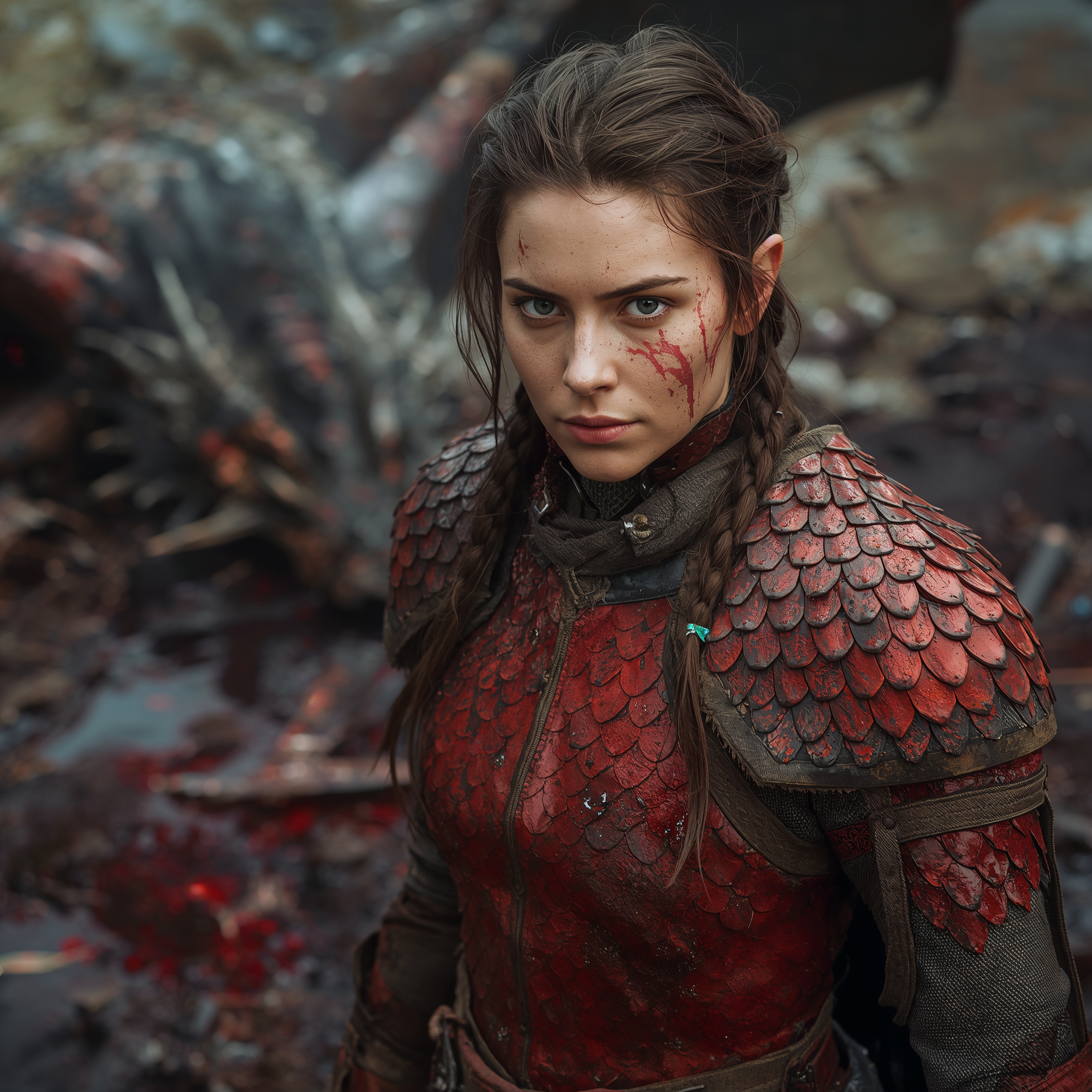
Kaela Veyr
Dragon hunter in reluctant retirementFamous, exhausted, and sharper than is socially convenient. Kaela wants a quiet exit from violence, but Brindlewash keeps handing her unfinished business.
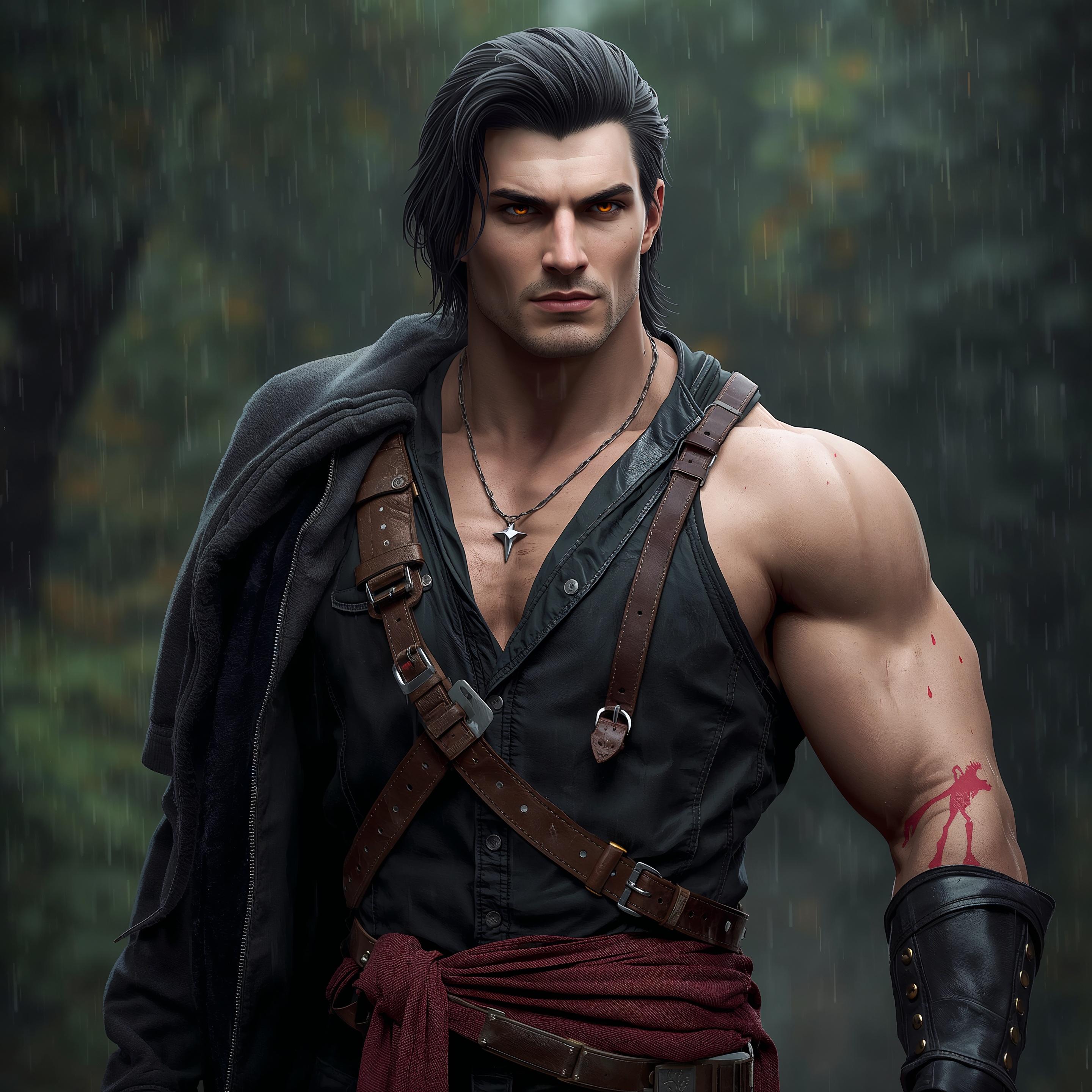
Captain Rusk Varran
Half-werewolf rivalRusk knows exactly how dangerous Kaela is and cannot understand why she would ever put the sword down. He is loyal, infuriating, and far too perceptive.
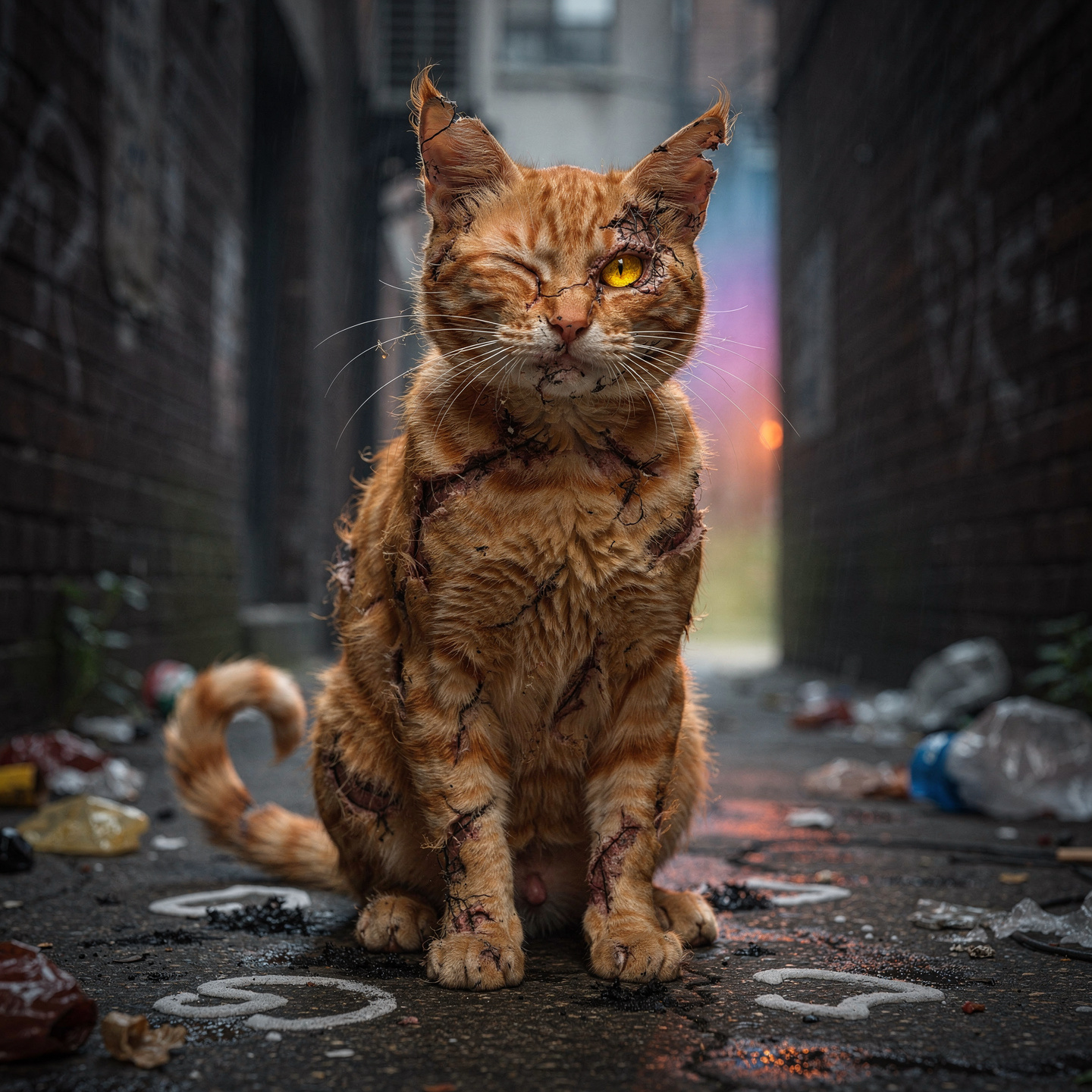
Crumpet
Familiar and evidence thiefOne-eyed, marmalade, allegedly demonic, and absolutely committed to stealing objects seconds before people realise they matter.
Mira VeyrKaela's mother, now haunting the laundromat's brass washer with unfinished business and strong opinions.
Borrik ThimblegritDwarven assistant, boiler expert, and keeper of secrets he would rather not explain before tea.
Rowan AshvalePresumed-dead ex-lover, steam-rune engineer, and owner of several explanations that are overdue.
Mrs. Pella WicksNeighbour, matchmaker, pie-bringer, and local authority on whether grief needs an eligible widower.
Read the preview of the prologue.
Prologue: The Letter That Ended the War
A first taste of Kaela's return to Brindlewash, before the ghosts, ledgers, romantic disasters, and cat-based theft truly get organised.
Blood, Brass and Bad News
The dragon died badly.
Most things did, when Kaela Veyr was paid to make sure of it.
It crashed into the western ridge at dusk, wings shredded, throat opened, one burning eye still fixed on her as if personally offended by mortality. Its body slid down the blackened slope in a slow avalanche of scales, blood, and broken stone. Steam rose where its blood struck the snow. The smell was iron, ash, and expensive leather ruined forever.
Kaela stood with one boot planted on a cracked boulder, one hand on the hilt of her sword, and tried very hard to feel triumphant.
She managed tired.
Triumph had been easier at twenty, when dragons had seemed like monsters and contracts had seemed like destiny. At thirty-two, dragons were still monsters, but only in the same way storms were monsters, or hunger, or men with too much authority and not enough imagination. They killed because killing was in them. Humans had less excuse.
Behind her, the mercenary company cheered.
Someone blew a horn. Someone else started singing the second verse of Fire in the Belly, Gold in the Hand, which was already an unforgivable crime in civilised regions. Three soldiers were arguing over who had technically struck the killing blow, even though Kaela had carved through the dragon’s wing joint, taken two ribs of fire across her breastplate, and buried her sword under its jaw.
Men were very committed to inventing reasons they were important. It kept them warm at night, presumably.
Kaela pulled her blade free from the frozen mud. The steel came loose with a wet sound and a shimmer of heat along the runes. The dragon’s blood hissed against the enchantments, bubbling like stew.
“Graceful work,” said a voice behind her. “If one overlooks the part where you were briefly on fire.”
Kaela did not turn.
“Briefly,” she said, “is the important word.”
Captain Rusk Varran climbed over a fallen chunk of basalt and came to stand beside her. He moved with the loose, predatory ease of a man who had never once entered a room without calculating who he could kill in it. He was broad through the shoulders, dark-haired, and scarred across the mouth in a way that made his smile look either dangerous or indecent, depending on the light.
The light at present was dragonfire and sunset, which did him no favours and several advantages.
His wolf-side showed after battle. It always did. His eyes were too bright, amber cutting through the grey dusk. His canines looked a fraction too sharp when he smiled. The nails on his right hand had darkened into claws, though he had the decency to keep them away from anything delicate.
Kaela had known Rusk for seven years. Fought beside him. Fought against him. Drunk with him once, which had been a tactical error. Nearly kissed him twice, which had been worse because she had been sober both times.
He looked at the dragon. Then at her scorched armour. Then at the line of blood running from her temple to her jaw.
“That will scar.”
“Everything scars.”
“That was nearly poetic. Are you dying?”
“Not fast enough to avoid this conversation.”
Rusk’s grin deepened. “There she is.”
Kaela wiped her sword on a strip of dragon wing membrane. It smoked. The sword, not the membrane. Dragon biology was absurd. Somewhere, some scholar had probably written a ten-volume thesis on the reactive alchemical properties of wyrmblood. Kaela’s own research findings could be summarised as: bad on boots, worse in hair.
Rusk leaned closer, sniffed, and frowned.
She glared at him. “Do not.”
“You smell like smoke, snow, dragon blood, and woman in a terrible mood.”
“That is because I am sophisticated.”
“You are bleeding.”
“I noticed.”
“From the head.”
“Still noticed.”
He reached for her anyway.
Kaela caught his wrist before his thumb could touch the cut at her temple. His pulse beat hard beneath her fingers. Rusk’s gaze dropped to where she held him. For a moment, the battlefield receded: the cheering, the moaning wounded, the crackle of dying fire, the stink of split dragon gut. There was only his hand in hers and the old, aggravating heat between them.
Not love. Never that.
Attraction, perhaps. Rivalry with its shirt half-unbuttoned. Loneliness wearing good shoulders.
Rusk did not pull away.
“You should let someone tend that,” he said quietly.
“You volunteering to play nurse?”
His smile turned sharp. “For you? I would be unbearable.”
“You are already unbearable.”
“Then imagine me with bandages.”
Against her better judgement, Kaela did.
She released his wrist.
“Stop looking pleased with yourself.”
“I have so little else.”
That was almost funny. Worse, it was almost intimate.
Kaela turned away before her face did anything treacherous. Across the battlefield, the last of the dragon’s fire guttered in blue tongues along the stones. The mercenary company moved through the wreckage, checking bodies, gathering weapons, cutting salvage from the dead creature before the blood cooled too much to sell.
War was many things, but mostly it was accounting with screaming.
Rusk followed her gaze. “We lost fourteen.”
Kaela closed her eyes for half a breath.
Names came to her whether she wanted them or not. Pell with the crooked nose. Iva who kept carved birds in her pack. Rennick, who had cheated at cards because he was bad at cheating and liked getting caught. Fourteen living souls turned into numbers before dinner.
“The contract paid for thirty,” Rusk said.
She opened her eyes. “Do not make that sound like victory.”
“I am making it sound like survival.”
“Same lie, better boots.”
His expression flickered. Not hurt, exactly. Rusk did not do hurt in public. But something behind his eyes stepped back and barred the door.
He looked out over the battlefield again. “The northern pass is open. The drake clans will scatter. Another month and the duke’s road will be safe.”
“For merchants.”
“For villages too.”
“For tax collectors.”
“You used to like winning.”
Kaela looked at the dead dragon, its massive head half-buried in snow, one horn snapped, the other pointing toward the bruised sky like an accusation.
“I used to be worse at counting.”
Before Rusk could answer, something clicked overhead.
Both of them looked up.
A brass raven dropped from the smoke.
It was no larger than a real bird, but heavier, its wings ticking with clockwork joints and its belly glowing faintly with message-heat. It spiralled once above the battlefield, shedding sparks, then dipped toward Kaela.
The raven landed on the dead dragon’s horn with a metallic clack. Its head jerked from side to side. Glass eyes brightened.
“Kaela Veyr,” it croaked.
The voice was official, reedy, and faintly smug. Even messenger constructs had adopted bureaucracy’s worst habits.
Rusk looked at the raven. “Fan mail?”
“If it asks for an autograph, shoot me.”
The bird opened its beak. A small cylinder slid out and struck the dragon horn, rolling once before Kaela caught it.
Black wax sealed the tube.
No crest she recognised.
No battlefield mark.
No mercenary code.
Just a pressed symbol: a basin, three rising curls of steam, and a crescent moon.
Kaela’s breath stopped.
The world kept moving without her permission. Men shouting. Snow hissing on hot scales. Rusk saying her name once, then again.
She broke the seal.
The parchment inside was too clean for a battlefield. Cream-coloured. Formal. Folded with a clerk’s precision. It smelled faintly of lavender soap and ash.
Kaela read the first line.
Then she read it again, because language was stupid and sometimes failed at its only task.
To Kaela Veyr, daughter of Maren and Tollen Veyr, formerly of Brindlewash.
Her fingers tightened.
It is my solemn duty to inform you that your parents have perished following an accident at the premises known as The Suds & Sigils Laundromat.
Accident.
The word sat on the page like a rat pretending to be furniture.
Kaela kept reading.
The incident occurred during a late maintenance cycle of the primary ward-boiler. Both parties were discovered deceased at the scene. Their remains have been respectfully prepared according to local custom, pending your return or written instruction.
Her mother had hated local custom. Said half of it was just old men making grief more expensive.
As surviving heir, you are required to present yourself in Brindlewash to settle matters of inheritance, outstanding debts, and property transfer.
Outstanding debts.
Her parents were dead, and someone had included outstanding debts by the second paragraph.
Kaela became aware of Rusk watching her.
“What is it?”
She did not answer.
At the bottom of the letter was a signature.
Magistrate Edric Halvane
Civic Office of Brindlewash
Beneath it, in smaller script:
May the Moon Receive Them Clean.
Kaela stared at that phrase until the letters blurred.
A memory rose without mercy.
Her mother at the washbasin, sleeves rolled to the elbow, dark hair streaked with soap bubbles, laughing as six-year-old Kaela dropped a muddy shirt into the rinse water.
“Again, little spark. Dirt always thinks it has the final word. We teach it manners.”
Her father in the back room, oil on his hands, singing off-key while he adjusted the brass pipes. Her mother shouting that if he made the boilers whistle during supper one more time, she would marry a sensible man with no tools.
The three of them eating honey cakes on the laundromat roof during the summer moonfall festival, watching silver lights drift over Brindlewash while Kaela declared she would never leave.
Children were liars by accident. Adults had to practise.
Rusk’s voice dropped. “Kaela.”
She rolled the parchment and shoved it back into the tube. Her hands did not shake. She was proud of that for half a second, then ashamed of being proud.
“My parents are dead.”
Rusk’s expression changed.
It was small, almost invisible, but she saw it. The captain vanished. The wolf retreated. The man remained.
“I am sorry.”
The words were simple. No performance. No dramatic oath. No battlefield nonsense about honour or the gods.
That almost undid her.
So Kaela did what she always did. She turned away from kindness and looked for a task.
“I need to get back to camp.”
“I will come with you.”
“No.”
“Kaela.”
“No,” she repeated, sharper.
Rusk’s jaw flexed. “You just received death news on a battlefield while covered in dragon blood. Allow me the wild indulgence of concern.”
“I said no.”
He stepped closer. The warmth of him cut through the cold.
“And I heard you. Tragic, how ears work. I am still coming.”
She looked up at him. “Captain Varran, if you take one more step, I will make you regret developing feelings.”
The words struck both of them.
Too close.
Too true, perhaps.
Rusk stopped.
His face hardened into something easier to deal with. Pride. Irritation. Armour. They both had fine collections.
“Feelings?” he said. “For you? I have had infected wounds I trusted more.”
“Good. Go tend one.”
For a moment, she thought he might argue. Or worse, say something kind again.
Instead, he gave her a short bow, mocking at the edges.
“As my lady dragon butcher commands.”
“Do not call me that.”
“I would stop if you stopped answering to it.”
Kaela walked past him.
The brass raven launched itself from the horn and followed.
“Message delivered,” it croaked.
“Go away.”
“Awaiting return receipt.”
“I said go away.”
“Verbal refusal logged.”
Kaela considered throwing a knife at it, but the raven was probably expensive and belonged to a civic office. Also, she had only three good throwing knives left, and wasting one on a bureaucratic bird felt like letting civilisation win.
She crossed the battlefield without speaking to anyone.
The mercenaries moved out of her path. Some nodded. Some saluted. One young recruit, face streaked with soot and awe, opened his mouth as if to say something heroic.
Kaela looked at him.
He reconsidered existence.
By the time she reached the encampment, night had folded itself over the mountains. The tents huddled in crooked rows below the ridge, canvas snapping in the wind, lanterns swinging from iron hooks. Steam wagons lined the eastern side, their brass tanks ticking as they cooled. The company’s artificers had already set up the field stills to render dragon fat. The smell would be appalling by midnight and profitable by morning.
Kaela’s tent stood apart from the others.
Not because she wanted privacy, though she did.
Because things tended to explode around her.
Inside, it was warm from the rune-brazier and cluttered with the evidence of a life she had not meant to build. Maps. Contracts. Spare blades. Dragon teeth in a jar. Armour polish. Burn salve. Three unopened letters from commanders seeking her service. A cracked hand mirror. A bottle of apple brandy stolen from a duke who had tried to underpay her.
And, tucked into the inner frame of her travel chest, one old sketch.
Rowan Ashvale.
The charcoal lines were faded now, softened by years and weather. He had drawn it himself as a joke, because Rowan had possessed the insufferable ability to be good at things casually. In the sketch, he leaned against a workshop bench, hair falling over one eye, mouth curved as if he knew exactly how charming he was and had decided to be forgiven in advance.
Kaela had hated that mouth.
Loved it too.
That had been the problem.
She sat on the edge of her cot, still in armour, and stared at the sketch until the tent seemed smaller than it was.
Rowan had died in spring rain.
Or so she had been told.
There had been a hunt. A black-scaled wyrm near the eastern marshes. Bad terrain. Bad information. A worse employer. Rowan had been there as the company’s steam-rune engineer, laughing at danger, flirting with her over a pressure valve, promising that after the contract they would go somewhere with soft beds and no reptiles larger than goats.
Then smoke. Mud. Screaming. A bridge collapsing into fire.
No body.
Only his broken compass found in the reeds, the glass cracked, the needle spinning uselessly.
People said no body meant hope.
People were idiots.
No body meant the mind did the burial itself, every night, with fresh details.
Kaela took the sketch from the chest frame and set it on her knee.
“You would have known what to say,” she murmured.
That was a lie. Rowan would have said something charming, inappropriate, and only accidentally helpful. Then he would have held her until she believed herself less alone.
She hated him for being dead.
She hated him more for having once made her happy enough that death could ruin her.
The brass raven hopped onto her writing desk.
“Return receipt pending.”
Kaela looked at it.
The raven clicked.
She looked at the dragon tooth jar.
The raven wisely hopped behind an ink bottle.
Kaela removed the message tube from her belt and read the letter again.
The words did not improve.
Parents dead.
Accident.
Ward-boiler.
Inheritance.
Debts.
Return.
No mention of details. No mention of Borrik Thimblegrit, her mother’s dwarven assistant, who had worked at The Suds & Sigils since Kaela was small enough to nap in a laundry basket. No mention of damage to the building. No mention of whether the bodies had been burned, crushed, cursed, drowned in boiling soap, or whatever new indignity the universe had prepared.
An accident at a laundromat.
Her mother had once beaten a hexed mangle into submission with a rolling pin. Her father had rebuilt a steam pump during a flood while standing waist-deep in enchanted runoff and singing drinking songs. They did not simply die in maintenance accidents.
Kaela stood.
Too fast.
The tent tilted.
She caught the centre pole and breathed through her nose until the world settled.
Outside, the camp laughed and cursed and lived. Someone had started playing a fiddle. Someone else was losing money loudly. The wounded groaned in the surgeon’s tent. The war rolled on, hungry as ever.
Kaela had nowhere in it she wanted to be.
That thought came quietly.
She nearly missed it.
She had been trying to retire for two years.
No. Longer.
Two years since she admitted it. Five since her hands began aching in winter. Seven since Rowan. Ten since killing stopped feeling like proof of anything. Every contract had been the last. Every dragon the final beast. Every payment the number that would buy land, silence, maybe a cottage by a river where no one asked her to be brave.
Then another village burned. Another lord begged. Another captain offered gold. Another monster rose from mist and hunger.
And always, someone said, Who else can do it, if not you?
A flattering cage was still a cage.
She looked around the tent at the blades, the armour, the maps pinned with red markers. A life made of emergency. A woman assembled from other people’s need.
The raven clicked again.
“Receipt?”
Kaela picked up the nearest boot and threw it.
The raven dodged.
The boot struck the tent wall and startled a swear out of someone passing outside.
“Veyr?” called a voice. “You alive?”
“No.”
“Right. Good.”
Footsteps retreated.
Kaela exhaled.
Then she noticed something inside the message tube.
Not the official parchment. Something caught deep in the brass cylinder. A second slip, thinner than the first, wedged beneath the inner seam.
She drew her knife and pried it loose.
The paper was cheap, grey, and torn at one edge. No seal. No signature. Just a few lines written in cramped block letters.
Her heart changed rhythm.
Not fear.
Recognition.
Borrik had always written like each word owed him money.
Little Spark,
Kaela sat very still.
No one called her that anymore.
If this reaches you, your mother’s dead and the magistrate’s lying through his clean white teeth. Your father too, gods rest the stubborn fool. Don’t trust the official account. Don’t trust anyone asking about the ledgers. Don’t let them wash the basement floor.
Her hand tightened around the note.
There was more.
She said if the whites come out grey, check the spring. I don’t know what that means. She said you would.
Kaela did not.
That was worse.
At the bottom, the ink had smeared, as if written in haste or with a shaking hand.
Come armed. Come quiet. Burn this.
No signature.
None needed.
Kaela read it three times.
Then she held it over the rune-brazier.
The paper blackened, curled, and vanished into a thread of smoke.
The official letter lay on her cot, polite and bloodless.
The hidden message remained behind her ribs like a hook.
The tent flap opened.
Kaela’s sword was in her hand before thought arrived.
Rusk stood in the entrance, one brow raised, his hands lifted slightly.
“I knocked.”
“No, you did not.”
“I considered it.”
“Get out.”
He looked past her to the brazier. His nostrils flared.
Wolf senses. Damn him.
“You burned something.”
“I cook all my correspondence. Adds flavour.”
His gaze returned to her face. “You are leaving.”
“That is not a question.”
“No. It is me being right.”
Kaela sheathed her sword with more force than necessary. “Congratulations. Have a biscuit.”
Rusk stepped inside and let the flap fall closed behind him.
The tent became very small again.
“You cannot leave now,” he said. “The company moves north at dawn. The duke’s second contract is already signed.”
“By you.”
“On behalf of us.”
“There is no us in paperwork.”
His amber eyes flashed. “There is in battle.”
Kaela laughed once. It came out harsh. “That is exactly the problem.”
Rusk went quiet.
Outside, the fiddle had moved into a slower tune. Something old and mournful. Mercenaries were sentimental creatures after killing things. It balanced the books, perhaps.
“My parents are dead,” Kaela said. “Someone may have murdered them. I am going home.”
“Then I will send riders.”
“No.”
“I will come.”
“No.”
“Kaela.”
The softness in his voice angered her more than shouting would have.
“You need me here because I am useful,” she said. “Do not dress it up.”
Rusk’s face closed.
For a moment, he looked every inch the mercenary captain: proud, commanding, carved out of hard choices and old hunger.
Then he said, “That is not the only reason.”
Silence unfolded.
An inconvenient silence. The sort that leaned close and waited.
Kaela should have stepped back.
She did not.
Rusk crossed the space between them slowly, giving her every chance to stop him. She hated that. Hated that he knew her well enough not to crowd unless invited. Hated that some reckless, bruised part of her wanted to be crowded anyway.
He lifted his hand, paused, then touched two fingers gently beneath the cut at her temple.
This time, she let him.
His thumb brushed away dried blood.
“You are allowed,” he said, “to not be steel for one night.”
Kaela’s throat tightened.
There were a dozen things she could have said. Sharp things. Safe things. Cruel things, if she needed room to breathe.
Instead, she whispered, “I do not know what is left if I stop.”
Rusk’s expression changed.
Not triumph. Not pity.
Understanding.
That was dangerous.
He leaned closer. His breath warmed her cheek. For one mad second, she thought he might kiss her.
For one madder second, she thought she might let him.
Then the brass raven croaked from beneath the desk.
“Return receipt pending.”
Kaela closed her eyes.
Rusk stared at the bird.
“I am going to eat that.”
“It is civic property.”
“I will pay the fine.”
The laugh surprised her.
Small. Broken at the edges. Real enough to hurt.
Rusk smiled, and this time there was no mockery in it.
The almost-kiss passed, but not cleanly. It left heat behind. It left questions. It left his hand near her face and her heart acting like an idiot in armour.
Kaela stepped away.
“I leave before dawn.”
Rusk dropped his hand. “The roads south are unsafe.”
“I am unsafe.”
“Not the same thing.”
“It has worked so far.”
“It has not.” His voice sharpened. “Look at you.”
She did.
Armour scorched. Hands scarred. Hair smelling of dragon blood. A dead lover’s sketch on the cot. A dead mother’s secret in the ashes. A life full of victories that had somehow brought her nowhere she wanted to stay.
Rusk saw too much.
So she gave him the part that was useful.
“I need three days’ rations, two horses, and no farewell speech.”
“You will take six days’ rations.”
“Four.”
“Five and a spare pistol.”
“I hate pistols.”
“I know. That is why you forget enemies use them.”
She looked at him.
He looked back.
The negotiation felt absurdly like tenderness.
“Fine,” she said.
“I will have the quartermaster prepare it.”
“Quietly.”
His mouth twisted. “You wound me. I am the soul of discretion.”
“You once announced an ambush by howling.”
“It was tactically unsettling.”
“It was stupid.”
“It worked.”
“The hill caught fire.”
“So did morale.”
Kaela shook her head, and for one breath, the grief loosened enough that she could stand beneath it.
Rusk moved to the tent flap, then stopped.
“When you are done,” he said, not looking at her, “come back.”
Kaela said nothing.
His shoulders rose and fell.
“To the company,” he added.
Still she said nothing.
He glanced back then, eyes bright in the brazier-light. “Or do not. But send word you are alive, or I will come looking.”
“That a threat?”
“Yes.”
“Good. I understand those.”
His smile was brief and sadder than she liked.
Then he was gone.
The cold slipped in after him and settled around her boots.
Kaela stood alone in her tent with the official letter, the dead man’s sketch, the smell of burned paper, and the sudden, terrible shape of a road home.
Home.
Brindlewash.
The Suds & Sigils Laundromat.
Her mother’s laugh. Her father’s songs. Soap bubbles drifting through summer air. The roof under her bare feet. Rowan’s hand in hers behind the boiler room, both of them too young to understand that love did not protect anyone simply by being true.
Parents dead.
Magistrate lying.
Ledgers.
Basement floor.
Check the spring.
Kaela removed her armour piece by piece. Breastplate. Pauldrons. Gauntlets. Greaves. Each hit the rug with a dull weight. Beneath it, she was sweat-soaked, bruised, and cold.
Not a champion.
Not a legend.
Just a daughter who had stayed away too long.
She packed before she could think better of it.
Two shirts. One spare pair of trousers. Coin purse. Burn salve. Whetstone. The apple brandy. Rowan’s sketch, though she cursed herself as she tucked it into the inner pocket of her coat.
Then she paused.
At the bottom of the travel chest lay a small square of embroidered cloth.
A wash token.
Her mother had given it to her the day Kaela left Brindlewash. A silly thing, stitched with blue thread and protective laundry charms, because Mira Veyr had believed there was no wound, curse, stain, or heartbreak that could not be improved by proper washing.
Kaela had carried it through fourteen countries, three wars, seven dragon contracts, and one grief she had never spoken aloud.
She picked it up.
The stitching warmed against her palm.
For the first time in years, the charm stirred.
Blue light threaded through the pattern. Once. Twice.
Then the cloth went cold.
Kaela stared at it.
Outside, the camp continued its loud, brief life. Men and women drank because they had survived. The dragon cooled on the ridge. The snow fell harder.
On her desk, the brass raven crept cautiously into view.
“Return receipt pending?” it tried.
Kaela looked at the bird.
Then at the official letter.
Then at the ashes in the brazier.
“Receipt,” she said, “is as follows.”
The raven’s eyes brightened.
Kaela took the magistrate’s letter, turned it over, and wrote on the back with a battlefield pen.
Kaela Veyr acknowledges receipt.
She paused.
Then added:
Tell Magistrate Halvane I am coming home.
Another pause.
A smile touched her mouth, though it held no warmth.
Tell him not to clean anything.
The raven clicked, recording.
“Message accepted.”
Kaela tied the letter back into the tube and fixed it beneath the raven’s belly.
The construct hopped to the tent opening, then turned its brass head.
“Additional sentiment?”
Kaela considered.
Grief pressed one hand to her throat.
Rage took the other.
Intrigue opened the road.
“Yes,” she said.
The raven waited.
Kaela leaned closer.
“If he lies to me,” she said softly, “I will fold him like wet linen.”
The raven clicked.
“Additional sentiment accepted.”
It launched into the night.
Kaela watched it vanish through the smoke and snow.
By dawn, the dragon would be butchered, the company would be marching north, and Captain Rusk Varran would be pretending he did not care which road she took.
By dawn, Kaela Veyr would no longer be the army’s champion.
She would be a daughter returning to bury her parents, inherit a failing laundromat, and find out why someone had murdered two people who knew how to make soap behave itself.
It was not retirement.
Not yet.
But for the first time in years, she was leaving a battlefield without looking for the next one.
That felt dangerously close to hope.
Naturally, it would probably get someone killed.
Listen to a Preview
Hear the prologue of Dragon Hunter's Dirty Laundry: Blood, Brass and Bad News.
Early Praise
★★★★★
"Cosy, clever, and so swoony I nearly set my own laundry on fire. A perfect autumn read."
— The Hearthside Reader
★★★★★
"The grumpy/sunshine dynamic of my dreams, wrapped in lavender sachets and woodsmoke."
— Bookish & Brewed
★★★★★
"Witches, wyrms, and a heroine who refuses to be rescued — until she really, really wants to be."
— Romance Realm Review