Three generations of Bramble women, three generations of ledgers, and a distillation practice licensed under a clause the civic code hasn't gotten around to closing. The oldest ledgers are the most magically active. Nessa has always known this without knowing what it meant. She is about to find out.
The book
The tonic doesn't put anything in. It only removes the seal on what's already there.
Nessa Bramble's memory-clarity tonic does exactly what it says — which is why Thursday's market ended with a deacon proposing to a hat stand, the tax collector being serenaded in the old modal-harmony style, and an eleven-year marriage making several accurate observations about the filing dates. The fault traces to a sealed clockwork vial she acquired from a mixed-estate lot. The vial traces to a clockmaker who has not opened the large cabinet in the back of his workshop in seven years.
When the cabinet opens, it contains Maribel — porcelain, brass, moonstone-eyed, and entirely awake. She knows Elian Gearwick's name. She knows his workshop. She holds three specific memories from before her wedding. She is not the woman he lost, and she is not going to pretend otherwise.
The sabotage trail in the tonic leads deeper than a contaminated vial: to Fenwick Mourne's commission ledger, to the Brindlewash Library's restricted texts, and to thirty years of women whom the civic archive recorded as missing and never once looked for. Nessa and Elian are not the only ones who need to know what happened to Maribel Saint. Maribel-the-construct does too — and her answer will not be the same as theirs.
The conspiracy is old. The evidence is filed where no one looks. The domestic archive — apothecary labels, laundry tags, recipe cards — has been keeping its own record all along.
For readers who like clockwork hearts, institutional villains caught by paperwork, love triangles that end in kindness rather than conquest, and small towns where the most dangerous person in the room has been indispensable for thirty years.
Welcome to Brindlewash
A town with very long records and several significant gaps in them.
Brindlewash keeps meticulous records. What it keeps them of, and which records survive thirty years of a very careful archivist, are different questions. Behind the civic ledgers there is a parallel archive — older, more honest, and built in objects that civic authority never thought to check: apothecary labels, laundry tags, recipe cards. The women Brindlewash misfiled wrote themselves down in the things they touched.
Elian Gearwick's workshop ticks — not because of any one clock, but because all the clocks together have established a collective rhythm the building has absorbed. The large cabinet in the back has been locked since he finished what was inside it and could not make himself open it. Seven years. Three weeks before a wedding. A mechanism with no key he chose to use.
The civic record says the women are missing. The apothecary labels, the laundry tags, the recipe cards say otherwise — and they cannot be forged, because the magic is embedded in the handwriting's emotional state at inscription. Hester Vane has spent thirty years ensuring no one with the training to read them has been in a position to look.
Meet the cast
An apothecary, a clockmaker, a bride built from essential parts, and one cat operating on a longer schedule than anyone has mapped.
The story centres on three people who need to answer a question that does not have the same answer for all of them, conducted inside a town that has been very carefully not looking at what is kept in its own records.
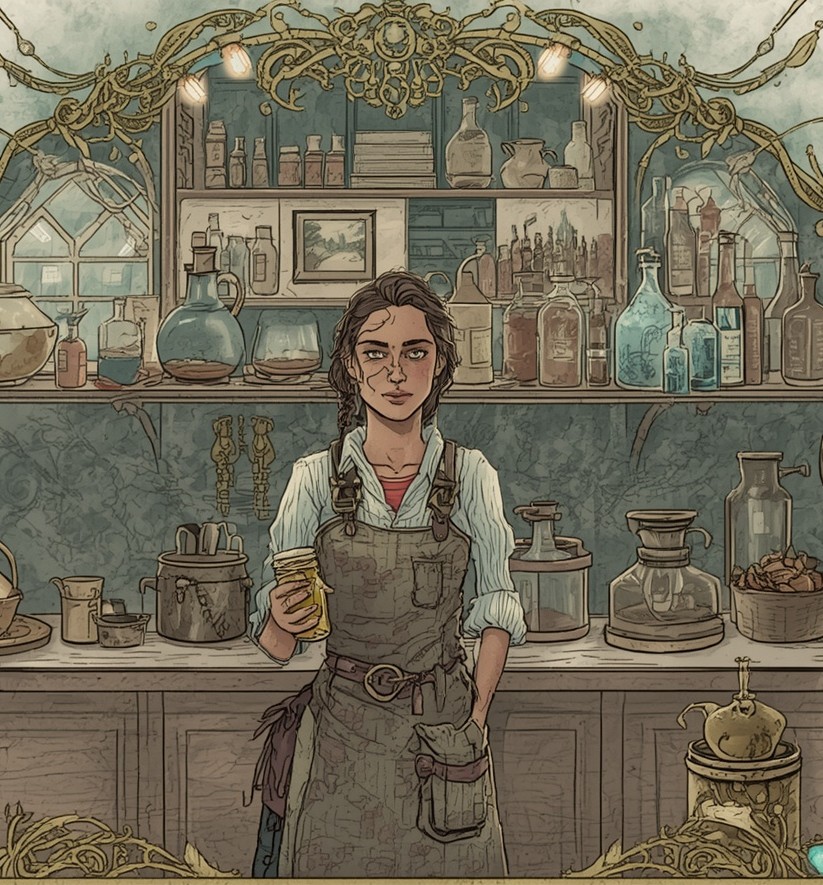
Nessa Bramble
Apothecary. Accidental love catalyst.Fast, warm, and specific in the way of someone who has been distilling variables their whole professional life and has pointedly avoided applying that skill to their emotional one. She believes every compound can be calibrated. She is about to administer the most uncalibrated thing she has ever made — something true, on purpose, without measuring the risk first.
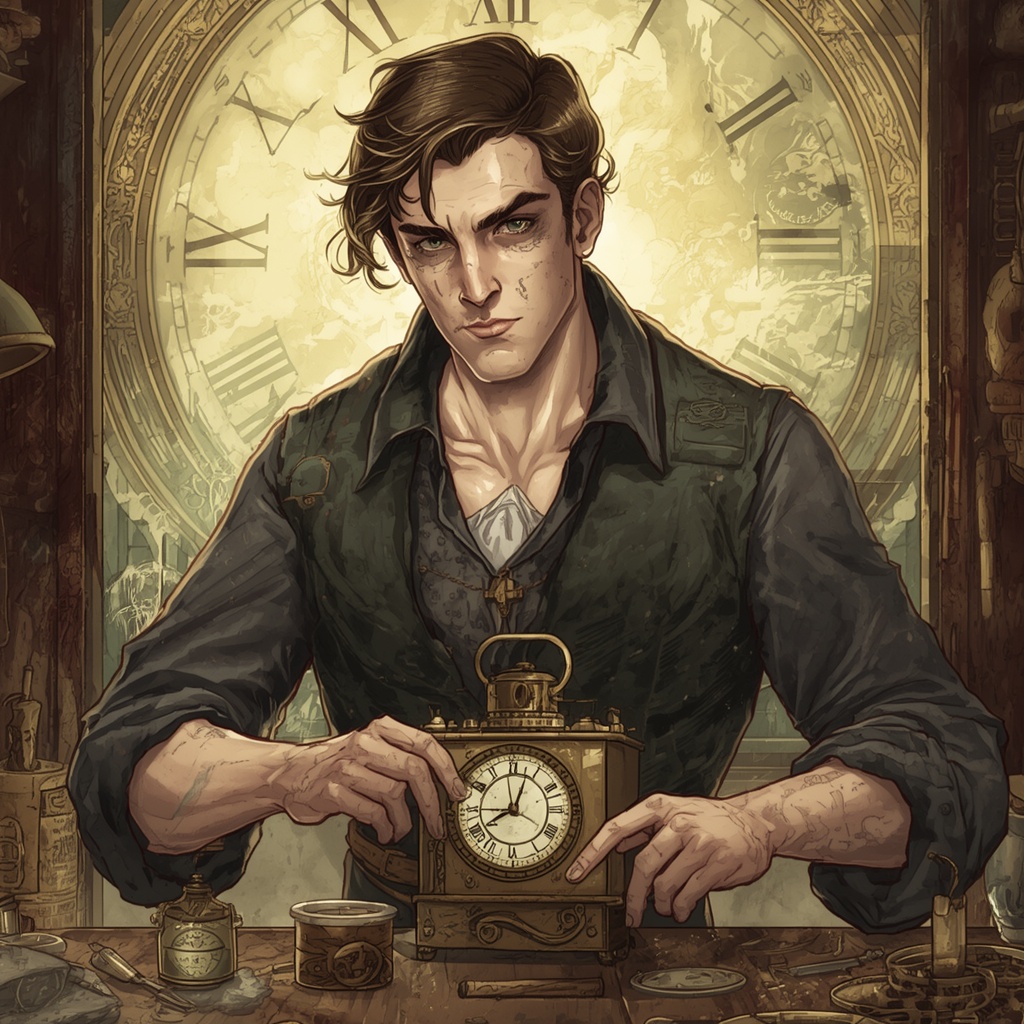
Elian Gearwick
Clockmaker. Keeper of careful grief.Quiet, precise, and handsome in the specific way of men who are not thinking about it. He builds things with extraordinary care because he believes that if he had been more careful, more exact, he would have seen what was coming. He has been maintaining a wound rather than healing it for seven years. The cabinet is opening whether he is ready or not.

Maribel
Clockwork bride. Her own work in progress.Porcelain, brass, moonstone-eyed, and entirely awake. She carries three specific memories from before someone else's wedding, a clockwork heart that ticks audibly when she is emotional, and no interest whatsoever in being managed. She is not Maribel Saint. She is what Maribel Saint considered most essential, preserved in the most urgent way available — and she gets to decide what comes next.
CrumpetOne-eyed, marmalade, and already sleeping inside Maribel's chest cavity before Elian has finished processing that the automaton has woken. He will bite the right person at the right moment. He will not explain. He is not present for his own banning from five establishments.
Hester VaneSenior archivist. Thirty years of civic service. A warm, helpful manner and a specific reflex when a cat bites her ankle. She has always framed what she does as protection. She has believed the framing long enough that she cannot tell the difference between the frame and the thing inside it.
Seraphina QuillKeeper of the Overdue Ledger and the library's institutional memory. She identifies the impossible library card and the hidden Saint family file. She does not discuss the Ledger's fines. She mentions that it has been "attentive" to a specific drawer in Hester's archive for several years.
Juniper CrakeAppears with emergency cake and truth-muffins she describes as a precautionary measure and Seraphina describes as entirely intentional and technically unprovable. Her emotional support arrives as a baked good and a statement of fact. Both are reliable.
Read the preview of chapter one.
Chapter One: A Tonic for Brave Idiots
Market day. The love tonic activates. A deacon proposes to a hat stand. A widower discovers a vocal range no one knew he had. The apothecary determines the fault is in the clockwork vial and goes to have a conversation about that.
A Tonic for Brave Idiots
The love tonic was not supposed to do this.
Nessa Bramble stood in the middle of Brindlewash market at ten past eleven on a Thursday and watched Clement Farthway — husband, deacon, civic councillor for the eastern ward, a man who had never in recorded Brindlewash history expressed anything beyond mild civic approval — lean over a barrel of Murrow's turnips and declare his absolute and unconditional devotion to the decorative hat stand outside Fielding's Haberdashery.
The hat stand did not respond.
Clement did not appear to require this.
'I have,' he announced to the square at large — or to no one human in particular, since the hat stand was receiving most of his focus — 'been wrong about many things. But not about this.'
Around him, Brindlewash's Thursday market was doing its level best to pretend nothing was happening and failing at two-thirds of the stalls.
Nessa's tonic batch was in all of the cake samples. She had made the cake samples herself, handed them out herself, and spent forty minutes being perfectly pleasant about it, because pleasant was good for business and because whatever was quietly going wrong with the batch was not yet visible from the outside.
She could see it now.
Across the square: Mervyn Holt, tax collector, a man of specific rigidity and minimal warmth, was being serenaded — serenaded, in the old Brindlewash modal-harmony style, with a song he should not have had the vocal range for — by a widower named Gable whose usual conversational range extended to weather, soil quality, and whether the civic drainage variance was finally being addressed. Gable's pitch was considerable. His eye contact was unwavering. Mervyn Holt was not sure what to do with either of these things.
At the cheese stand, a woman had stopped buying cheese to explain something to the cheese seller. The explanation appeared to be ongoing. The cheese seller was listening with the expression of a man watching a building he is fairly sure is structurally sound but about which he has recently developed questions.
Nessa set down her ledger. Picked it up again. Set it down.
She had brewed the tonic three weeks ago — a memory-clarity preparation, well within her licence, correctly distilled through her third-generation Bramble formula without modification. The formula was her family's oldest and most reliable: it did not manufacture emotion, it removed suppression around what was already present. A single sip was meant to produce twelve hours of manageable self-honesty. She had used it without incident for six years.
The clockwork vial had arrived in a mixed-estate lot two months prior, sealed, unlabelled, priced at eight shillings for the batch, and she had assumed — as one reasonably does — that it was empty. She had stored it in the distillation cabinet because it was a sensibly shaped vessel, and Nessa had a very organised system for sensibly shaped vessels, which was one of the reasons this particular failure was so specifically irritating.
She had the beginnings of a theory about the clockwork vial.
The theory was not good. The theory was, specifically, that the vial had not been empty.
'Excuse me,' said a woman at Nessa's elbow.
Nessa turned. The woman was wearing the expression of someone who had not eaten a cake sample and was deeply confused about why everyone around her had.
'Is that man proposing to a hat stand?'
Nessa looked at Clement Farthway, who had progressed from declaration to a more detailed accounting of his feelings and appeared to be settling in for the duration.
'He is,' Nessa said.
'Should someone—'
'He'll come through it in an hour or so. The hat stand isn't in a position to respond, which limits the consequences considerably.' She paused. 'Don't eat any of the shortbread from the middle table.'
The woman looked at the middle table with dawning horror.
'I've already had two pieces.'
Nessa closed her eyes for one second. The second had the quality of a rapid calculation being performed under adverse conditions.
'Who have you been thinking about?' she asked, professionally.
The woman stared at her.
'The locksmith,' she said, in an entirely different voice. 'Oh no.'
'The feeling was already there,' Nessa said, with the precision of someone who had explained this several times in the preceding twenty minutes and expected to explain it several more before the market closed. 'The tonic doesn't put anything in. It only removes the seal around what's already present. Everything people are saying today, they were already—'
'I told him he had a confident jaw.'
Nessa had nothing useful for that.
'I'm going to fix this,' she said instead. 'All of it. Do not eat anything else from this market today, including your own purchases, until I've confirmed the contamination radius.' She picked up her ledger and her distillation kit and began moving in the direction of the clocktower. 'I need to have a conversation with someone about a vial.'
Behind her, Brindlewash's market continued its recalibrated Thursday. Three more confessions in the first block alone. Two of them, from the brief survey Nessa allowed herself before turning the corner, appeared to be reciprocated. She filed this under manageable and kept walking.
On the corner of the market lane, sitting on top of a rain barrel with the settled patience of something that had been watching for a while, was the large marmalade cat who had been living in Nessa's cellar for the better part of three months under terms she had never formally agreed to.
He had one amber eye, a torn ear, and the moral confidence of a very well-placed tax loophole.
He was watching Clement Farthway with the expression of someone who had seen this coming.
'If you knew,' Nessa said to him, not stopping, 'that information would have been useful before the market.'
The cat blinked his one eye. Then, with the deliberate economy of something communicating through minimal means, he stood, stretched, and began walking in the same direction Nessa was walking.
Two paces ahead of her.
She let him lead. He had been ahead of her twice before in ways she had later identified as operationally significant, and she had decided that the most calibrated response to a cat with apparent situational intelligence was to let him demonstrate it and deal with the implications afterward.
The clocktower was six minutes north. She was there in four.
She knocked.
From inside: the sound of many clocks in amiable disagreement about the time, the particular deep resonance of a building that had absorbed years of mechanical rhythm into its own structure, and then — eventually — the silence before someone who has been very still decides to move.
Elian Gearwick opened the door.
He was in his working clothes, which looked the same as his other clothes. He had a gear mark across one cheekbone and a lens around his neck that he had clearly been using until approximately thirty seconds ago. He was looking at Nessa the way he always looked at Nessa: with the faintly arrested expression of someone who had prepared to deal with something simple and had just registered that it was not.
'The tonic,' he said.
'The tonic,' she agreed. 'And the vial it came from. Which I think may have originated in your estate lot. Which I need to discuss with you. Now, if possible, and before the cheese seller reaches any conclusions.'
A pause.
'There is a man outside Fielding's proposing to the hat stand,' he said.
'I know. I saw the beginning of it. The hat stand is, so far, noncommittal.' She stepped through the door. 'I need your distillation cabinet provenance records. I need them now, and then I need you to look at something I found in the base of the vial when I tried to clean it this morning.'
He stepped back to let her in and said, very specifically, 'What did you find?'
'A gear residue. Clockwork. Your mark — not Mourne's.' She set her kit on the nearest clear surface, which was not the nearest surface, because no surface in Elian Gearwick's workshop was clear without having been recently worked on. 'Someone put something in that vial. Something that interacted with my formula and stripped its target specificity. It's been distributing for three weeks in low-concentration ambient exposure through the tonic batch, and then the market samples concentrated it.'
He was very still for a moment.
'How long to neutralise?'
'Twenty-four hours for ambient, if we can identify the compound. The market acute cases I can counter-dose by mid-afternoon.' She turned to look at him properly. 'But I need to know where the vial came from. Which estate lot. Which auction. Which provenance.'
Elian looked at her for a moment in the way he sometimes looked at her — the way that took slightly longer than the question required — and then he said: 'There's something else. Come through.'
She followed him through the workbenches, past the lens arrangements, past the cabinet in the back that she had always assumed was locked.
The cabinet door was open.
From within came a sound that Nessa had never heard in any building she had ever been in. It was quiet. It was steady. It was the sound of a mechanism designed with enormous care and specificity for a single purpose.
It was, unmistakably, the sound of someone else's heart.
Ticking.
Early Praise
★★★★★
"Maribel is one of the finest characters I have read in years. She is assembled from grief and borrowed memory and she is completely, defiantly herself. I wept twice and neither time was sad."
— The Hearthside Reader
★★★★★
"The love triangle resolves with more genuine kindness than most romances manage with only two people. Hollybrook knows that letting go is an act of love. She proves it with considerable precision."
— Bookish & Brewed
★★★★★
"Crumpet is banned from five establishments by the end of this book. He is not present for the announcement. This is the correct resolution to every problem a cat has ever caused."
— Romance Realm Review