A bakery warm enough to fog its own windows from October through March. The shared wall with the beast cottage next door has a crack in it. Both tenants have been meaning to report it for eighteen months. On two occasions it has admitted a goat.
The book
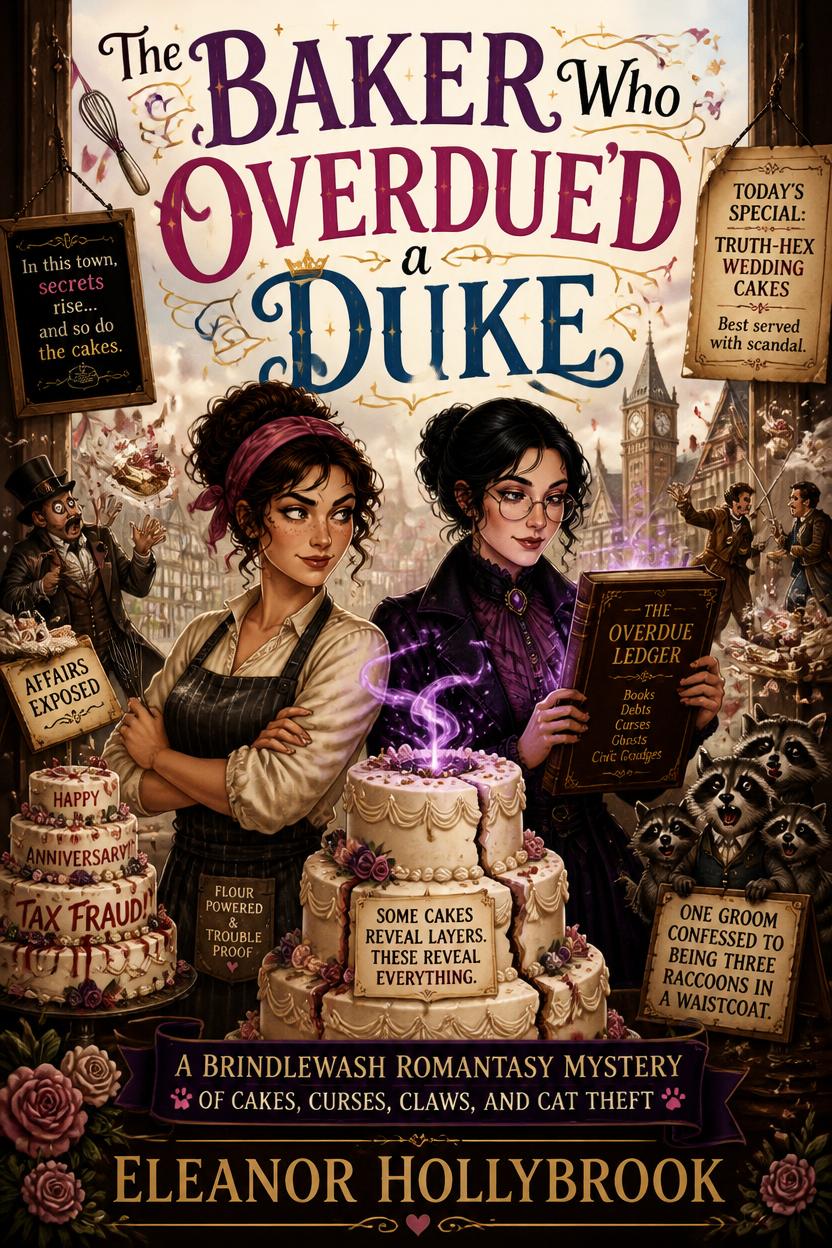
The truth was always going to come out. She just baked it in too early.
Juniper Crake has been running The Proving Ground for five years: measured, precise, and in complete professional control of everything except the one thing she baked into forty-eight portions of wedding cake on a Tuesday morning while telling herself she was fine.
Three dozen truth-hexed wedding cakes. One groom revealed to be three raccoons. The Mayor's tax fraud, confessed between courses. And a dead duke's grimoire, forty-seven years overdue, arriving through the library's returns slot at three in the morning.
The town's sharp-tongued baker and its meticulous librarian have nothing in common except a shared problem, a one-eyed marmalade cat who has already decided how this ends, and the dawning realisation that someone has been very carefully burying a murder inside Brindlewash's civic paperwork for the better part of half a century.
The conspiracy is old. The overdue fine is compounding. The marzipan wyvern has not yet been activated. There are nine days until the civic magic tears Brindlewash apart at its founding seams.
For readers who like cosy magic, inconvenient truths, slow burns conducted in the language of sourdough and library policy, and small towns where the paperwork is more dangerous than the villains.
Welcome to Brindlewash
A small town built on bound secrets and very inconvenient paperwork.
Brindlewash looks like a pleasant market town. It has rune-lamps, a respectable main street, a library that knows where you live, and neighbours who are aware of your business before you've finished having it. It was founded two centuries ago by seven families who sealed their civic agreements into physical objects — recipe books, ledgers, property deeds — that are still in circulation, still active, and still deeply inconvenient when disturbed.
The library's civic conscience made physical. It records every borrowed thing — books, names, secrets, debts — and fines people emotionally, in kind, for what they have withheld. The ledger cannot be argued with, appealed to, or tricked. It has been reading over Seraphina's shoulder since she took the post.
The duke was not a blackmailer. He was a vault, holding everyone's worst secrets to prevent them from being weaponised. He was killed the night he tried to dissolve the archive entirely — and his death was never officially filed. He has been legally alive for forty-seven additional years.
Meet the cast
Bakers, librarians, ghosts, and a goat with leverage.
The story centres on people who have been very carefully not-saying things for long enough that the not-saying has achieved structural mass. In Brindlewash, this tends to end up in the official paperwork one way or another.
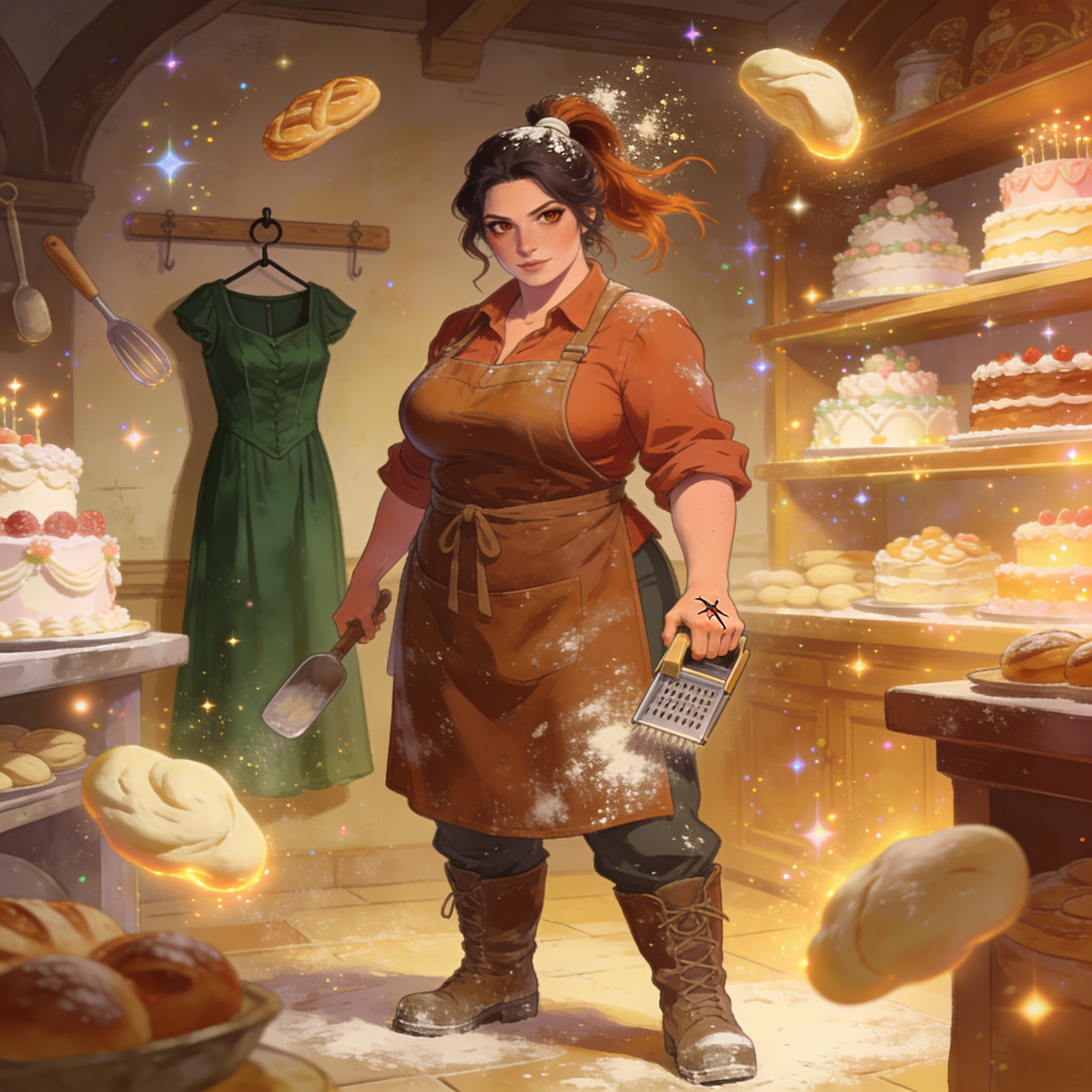
Juniper Crake
Baker. Accidental truth-witch.Precise, dry-humoured, and in complete professional control of everything except the sustained fury she's been categorising as "manageable" for two years. She bakes the way other people argue: with evidence, with patience, and with the quiet certainty that she is correct about the butter.

Seraphina Quill
Keeper of the Overdue LedgerTall, meticulous, possessed of posture that her predecessor described as architecturally sound. She has strong opinions about classification systems and states them at structurally inappropriate moments. She has been fined by the Overdue Ledger twice. She does not discuss the second time.

Crumpet
Civic familiar of notable investigative serviceOne-eyed, marmalade, and already present before anyone invited him. He swallows the cursed stamp in Chapter 3, produces its secrets in ecclesiastical Latin under butter-bribery in Chapter 6, and is formally entered into the founding ledger in Chapter 10. He accepts this with the air of someone who was expecting it.
Maddox ValeLicensed beast-tamer, Juniper's next-door neighbour for five years, and a man who has been choosing the wrong moment to say the actual thing since approximately the second month of their acquaintance.
Duke Orvyn BellweatherLegally alive since his death forty-seven years ago. He was not a blackmailer; he was the opposite. He has been waiting in the archive room to explain this. He is very apologetic about the cataloguing situation.
Aldous FinchSolicitor. No detectable pulse. Immaculate cuffs, always. A system that has been running on its own momentum for forty-seven years and has recently been redirected without noticing.
Admiral TrousersA goat. He has no magic. He simply knows things and deploys this knowledge without mercy, without warning, and always at the worst possible moment. His blackmail of Maddox is real and never explained. This is correct.
Read the preview of chapter one.
Chapter One: Three Dozen Confessions
The wedding cakes were delivered. The town's social calendar detonated shortly thereafter. Juniper Crake retreats to the Proving Ground and discovers that whatever has been sitting quietly under her sternum for two years has found a medium.
Three Dozen Confessions
The wedding cakes were a mistake.
Not the making — Juniper Crake had made wedding cakes for five years, and her process was sound. Measured. Repeatable to three decimal places on a scale her previous employer had described as excessive before she'd pointed out that imprecision was the reason he kept losing clients to the bakery on the other side of town, after which he had fired her and she had been right about that too.
The mistake was baking them angry.
Four hours. Three tiers. Twelve layers of vanilla sponge separated by burnt-honey cream, each pressed flat and cooled on wire racks she'd cleaned twice because the wire was the wrong kind of cold, because she'd been thinking very hard about something she categorised as not worth thinking about and had been thinking about it continuously for two years. The name of the thing she was not thinking about was Maddox Vale, who lived next door, and who on Tuesday mornings smelled like cedar and something herbal that came through the shared wall if the proofing drawer was open, which it always was on Tuesdays, because that was when she made the rye.
She had baked it in layer by layer, the not-thinking, pressing each tier flat with more force than was strictly necessary. She had not known this was possible.
The culinary hexwork manuals — found three days too late, in the reference section of a library that was increasingly reluctant to cooperate — would describe the phenomenon as accidental affective saturation: the transfer of a sustained emotional charge into foodstuffs via mechanical repetition and involuntary magical resonance. A truth-hex. Baked in by someone who had been carefully not-feeling something for long enough that the not-feeling had achieved structural load and looked for a medium to carry it.
Juniper had provided forty-eight portions of medium, in tiered form, with silver dragées.
She heard about the raccoons from the flower girl, who had been sent ahead because the maid of honour was having difficulty breathing and one-third of the groom had made a break for the orangery.
Juniper was in the Proving Ground's back kitchen, recalculating the proofing times on a batch of rye that was behaving oddly since morning, when the girl arrived. She listened to the full account standing at the bench with a spatula she forgot to put down.
Three raccoons. In a waistcoat. Stacked.
There had been a bottom raccoon, a middle raccoon, and a particularly determined raccoon at the top who had handled the vows with considerable confidence until the second slice of cake compelled the middle one to volunteer a confession about the ring.
'Which ring?' Juniper asked.
'The ring,' the girl said. 'The civic one. The binding ring from the founding charter. They'd had it for eleven years. They found it in a drain and kept meaning to return it and the cake made the top raccoon explain all of this in front of forty guests and the string quartet.'
Juniper set the spatula down.
'And the Mayor,' the flower girl continued, with the methodical energy of someone who had been holding this report together through sheer force of civic duty, 'is asking to be uncuffed from the pastry table. His wife is not assisting. The anniversary sponge said something about filing dates. He was very specific. She is now specifically angry about the filing dates.'
'Tax fraud?'
'Eleven years of it. He itemised.' The girl paused. 'Also three of the canapés have started producing statements about the eastern drainage variance.'
'The canapés.'
'They were made with the leftover sponge.'
Juniper looked at the proofing drawer.
The proofing drawer did not look back, because it was a drawer, but it made a low sound she'd never heard before, like a bell that had been struck once and immediately thought better of it.
She untied her apron. Tied it again because her hands needed something to do. Untied it a second time.
She had been telling herself, for two years, that what she felt about Maddox Vale was professionally manageable — a matter of proximity and shared wall and the fact that his kitchen smelled like something that had opinions about winter mornings. She was a baker. She understood the chemistry of heat and time and she had it under control. She baked six days a week on a schedule. She kept the proofing drawers at precise temperatures she had mapped herself. She was, in all material respects, a person who had it together.
She had baked the not-having-it-together into forty-eight portions and apparently that was what under control looked like from the outside.
'Tell the Mayor's wife I'm coming,' Juniper said. 'Tell her not to eat anything else. Particularly not the petit fours.'
'Why particularly the petit fours?'
Juniper considered the full geometry of the explanation and decided that Brindlewash had produced enough civic honesty for one morning.
'It's complicated,' she said. 'She'll understand.'
She followed the girl out into the street.
The morning was crisp and unhelpfully beautiful — wood smoke, the river, rosemary from the market stalls on the south end, and the particular quality of autumn light that had no interest in anyone's crisis. Brindlewash at nine in the morning was exactly itself: rune-lamps still amber against the pale sky, steam carts making their rounds, three members of the Civic Preservation Society arguing outside the stationers about something that sounded historical and personal in equal measure.
The Hartwell reception was two streets over and she could hear it before she reached the gate.
The crying was orderly. The shouting was not. Someone was playing the violin in a register that suggested either profound distress or a determined compositional experiment, and from behind the topiary she could hear a woman delivering what appeared to be a formally structured objection to something involving deeds.
Juniper pushed open the gate.
She was already calculating, in the part of her brain that did not stop even during social disasters, whether there was a legal distinction between baking a truth-hex accidentally and baking one on a schedule. The Civic Magic Regulatory Board handled culinary hexwork under Schedule 4, Subsection 11 — she'd checked once, on a slow January afternoon, out of professional curiosity and nothing else. She was fairly certain that intent was a mitigating factor. She was less certain about sustained emotional states over a four-hour bake cycle.
On the corner of the street behind her, a large marmalade cat with one amber eye sat on top of the post box and watched her go.
He was holding something in his mouth.
She could not tell what, from this distance.
She would, within forty-eight hours, develop very strong feelings about this.
The garden room's door was propped open with an overturned silver serving tray. Inside, Brindlewash's most attended social event of the season had reorganised itself into several distinct clusters: the weeping, the furious, the philosophically disturbed, and a small contingent near the bar who appeared to have decided that the most sensible response was to have another drink and see where the morning went.
The raccoons had been located. One was in the orangery. One was in the rose bed. The civic binding ring had been recovered by a junior councillor who was now holding it in both hands with the expression of someone who had opened a wardrobe and found a second wardrobe inside.
The Mayor's wife saw Juniper across the room.
The distance between them was approximately twelve feet, a toppled champagne tower, and the ruins of the anniversary tier.
'You,' said the Mayor's wife.
'It was accidental,' Juniper said.
'My husband confessed to eleven years of creative municipal accounting in front of the Deputy Herald.'
'I'm aware.'
'In itemised form.'
'The sponge tends to extract specifics. It's a structural issue with the layers, I think — the more tiers, the deeper the—'
'He cited filing dates,' the Mayor's wife said. 'He cited. Filing. Dates.'
Juniper had the professional grace not to point out that the filing dates were probably the most efficient part of the confession.
'I'm going to fix it,' she said instead. 'I don't know exactly how yet. But I will.' She looked at the ruins of the anniversary tier, at the silver dragées scattered across the tablecloth like civic wreckage. 'I'll need access to the culinary hexwork section at the public library.'
The Mayor's wife looked at her for a long moment.
'Seraphina Quill,' she said, 'is going to eat you alive.'
'Probably,' Juniper said. 'But she'll file the complaint correctly.'
She was right on both counts, as it turned out.
She was wrong about which of them would do the eating.
Early Praise
★★★★★
"Pratchett's bureaucratic absurdism met a slow-burn romance and they produced something genuinely perfect. I finished it in one sitting and immediately started over."
— The Hearthside Reader
★★★★★
"The most romantic thing I've read in years is a man addressing a goat with specific weariness. This book knows exactly what it's doing and does it with tremendous precision."
— Bookish & Brewed
★★★★★
"The civic magic system alone deserves an award. The slow burn will ruin you pleasantly. Crumpet should have his own series."
— Romance Realm Review